 njnir.com
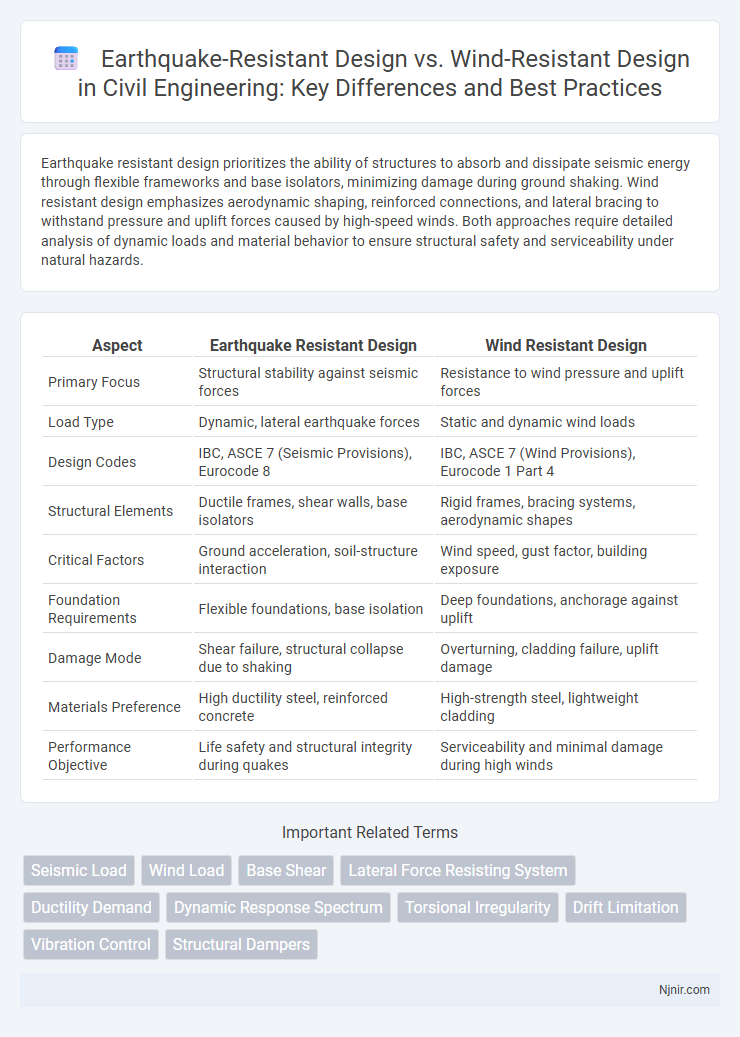
 Earthquake resistant design prioritizes the ability of structures to absorb and dissipate seismic energy through flexible frameworks and base isolators, minimizing damage during ground shaking. Wind resistant design emphasizes aerodynamic shaping, reinforced connections, and lateral bracing to withstand pressure and uplift forces caused by high-speed winds. Both approaches require detailed analysis of dynamic loads and material behavior to ensure structural safety and serviceability under natural hazards.
Table of Comparison
| Aspect | Earthquake Resistant Design | Wind Resistant Design |
|---|---|---|
| Primary Focus | Structural stability against seismic forces | Resistance to wind pressure and uplift forces |
| Load Type | Dynamic, lateral earthquake forces | Static and dynamic wind loads |
| Design Codes | IBC, ASCE 7 (Seismic Provisions), Eurocode 8 | IBC, ASCE 7 (Wind Provisions), Eurocode 1 Part 4 |
| Structural Elements | Ductile frames, shear walls, base isolators | Rigid frames, bracing systems, aerodynamic shapes |
| Critical Factors | Ground acceleration, soil-structure interaction | Wind speed, gust factor, building exposure |
| Foundation Requirements | Flexible foundations, base isolation | Deep foundations, anchorage against uplift |
| Damage Mode | Shear failure, structural collapse due to shaking | Overturning, cladding failure, uplift damage |
| Materials Preference | High ductility steel, reinforced concrete | High-strength steel, lightweight cladding |
| Performance Objective | Life safety and structural integrity during quakes | Serviceability and minimal damage during high winds |
Introduction to Earthquake and Wind Resistant Design
Earthquake resistant design focuses on constructing buildings and infrastructure that can withstand seismic forces generated by ground shaking during an earthquake, emphasizing flexibility, ductility, and energy dissipation. Wind resistant design targets the ability of structures to endure aerodynamic pressures and dynamic forces caused by strong winds, such as hurricanes and tornadoes, prioritizing lateral stability and material strength. Both approaches integrate advanced engineering principles and materials to enhance safety and durability under their respective natural hazards.
Key Principles of Earthquake Resistant Structures
Earthquake resistant design focuses on flexibility, ductility, and energy dissipation to withstand seismic forces, emphasizing base isolation systems and shear walls to reduce structural damage. Wind resistant design prioritizes aerodynamic shapes, stiffness, and lateral load resistance to counteract wind pressure and vortex shedding. Key principles in earthquake resistant structures include strong foundation anchorage, continuous load paths, and the use of materials that absorb and dissipate seismic energy effectively.
Fundamentals of Wind Resistant Building Design
Wind resistant building design focuses on developing structures that can withstand lateral forces caused by high-velocity winds, emphasizing aerodynamic shapes, reinforced framing, and secure cladding systems to prevent uplift and shear damage. Key fundamentals include understanding wind pressure distribution, implementing proper load paths to transfer forces to the foundation, and selecting materials with adequate strength and flexibility. Design codes such as ASCE 7 provide essential guidelines for wind load calculations and structural detailing to enhance building resilience against storm-induced stresses.
Material Selection for Seismic and Wind Resistance
Material selection for earthquake resistant design prioritizes ductile materials like reinforced concrete and structural steel that can absorb and dissipate seismic energy through deformation without failure. Wind resistant design focuses on materials with high tensile strength and stiffness, such as steel and engineered wood products, to withstand lateral wind pressures and prevent structural displacement. Both designs require durable connections and flexible joints, but seismic resistance demands more energy-absorbing capabilities, while wind resistance emphasizes rigidity and aerodynamic performance.
Structural Systems: Contrasting Approaches
Earthquake resistant design emphasizes ductility and energy dissipation within structural systems, employing elements like base isolators, moment-resisting frames, and shear walls to absorb seismic forces. Wind resistant design prioritizes stiffness and aerodynamic shaping to counteract lateral loads, often utilizing braced frames, rigid connections, and tuned mass dampers to reduce oscillations. These contrasting approaches reflect the distinct nature of dynamic loads: seismic events require flexibility and deformation capacity, whereas wind demands rigidity and vibration control.
Design Codes and Standards Comparison
Earthquake resistant design primarily adheres to codes like the International Building Code (IBC) and ASCE 7, which emphasize seismic load considerations, ductility, and energy dissipation capabilities to mitigate structural damage during ground motion. Wind resistant design follows standards such as ASCE 7 and the Minimum Design Loads for Buildings and Other Structures, focusing on aerodynamic loading, pressure distribution, and stiffness to resist uplift and sway caused by strong winds. The key difference in design codes lies in the load application: seismic codes prioritize dynamic lateral forces and ground acceleration effects, while wind codes emphasize steady-state and gust wind pressures, requiring distinct analytical approaches and safety factors.
Load Path and Force Distribution Strategies
Earthquake resistant design prioritizes a continuous and direct load path that effectively channels seismic forces from the structure to the foundation, ensuring energy dissipation through ductile materials and flexible connections. Wind resistant design emphasizes aerodynamic shaping and lateral load distribution, utilizing stiff frames and bracing systems to transfer wind forces evenly across the structure and foundation. Both approaches rely on strategically engineered force distribution, but earthquake design demands dynamic response management while wind design focuses on static and fluctuating pressure resistance.
Foundation Considerations for Seismic vs. Wind Loads
Foundation considerations for earthquake resistant design prioritize flexibility and energy dissipation to withstand seismic forces, often incorporating base isolators and deep pile foundations to mitigate ground motion effects. In contrast, wind resistant design focuses on lateral stability and uplift prevention, utilizing shallow spread footings reinforced to resist overturning moments and dynamic wind pressures. Soil-structure interaction is critical in both cases, but seismic foundations demand enhanced ductility and load redistribution capabilities compared to the stiffness and anchorage requirements typical of wind-resistant foundations.
Economic Implications and Cost Analysis
Earthquake resistant design requires specialized materials and construction techniques that increase initial costs but reduce long-term expenses related to damage repair and loss of life. Wind resistant design typically involves lighter structural reinforcements and aerodynamic considerations, often resulting in lower upfront investment but varying maintenance costs depending on local wind conditions. Cost analysis must factor in regional hazard probabilities, insurance premiums, and potential downtime to determine the most economically viable strategy for resilient infrastructure.
Future Trends and Innovations in Resistant Design
Future trends in earthquake-resistant design emphasize the integration of advanced materials such as shape memory alloys and base isolators, which improve structural flexibility and energy dissipation. Innovations in wind-resistant design focus on aerodynamic building shapes and active control systems like tuned mass dampers to mitigate dynamic wind loads. Both fields increasingly leverage smart sensors and AI-driven modeling to optimize real-time structural responses and enhance overall resilience against natural forces.
Seismic Load
Seismic load considerations in earthquake resistant design prioritize dynamic ground motion effects and lateral forces to enhance structural stability, whereas wind resistant design primarily addresses steady and fluctuating wind pressures with different load patterns.
Wind Load
Wind resistant design prioritizes structural integrity by accounting for dynamic wind loads, pressure variations, and aerodynamic effects to prevent building sway and facade failure.
Base Shear
Base shear in earthquake resistant design is calculated using seismic forces considering ground acceleration and building mass, while in wind resistant design, it is determined by aerodynamic forces based on wind pressure and building surface area.
Lateral Force Resisting System
Earthquake resistant design employs ductile lateral force resisting systems like moment-resisting frames and shear walls to absorb seismic energy, while wind resistant design prioritizes rigid, stiff systems such as braced frames and diaphragms to withstand steady lateral wind pressures.
Ductility Demand
Earthquake-resistant design requires higher ductility demand to absorb and dissipate seismic energy through inelastic deformation, whereas wind-resistant design typically involves lower ductility demands emphasizing stiffness and strength to withstand aerodynamic forces.
Dynamic Response Spectrum
The dynamic response spectrum analysis reveals that earthquake-resistant design prioritizes vibration frequency content and transient ground motion effects, whereas wind-resistant design emphasizes steady-state aerodynamic forces and fluctuating pressure distributions on structures.
Torsional Irregularity
Torsional irregularity significantly affects earthquake-resistant design by requiring enhanced structural symmetry and stiffness distribution, whereas wind-resistant design prioritizes aerodynamic shaping and lateral load resistance with less emphasis on torsional effects.
Drift Limitation
Drift limitation in earthquake resistant design focuses on controlling lateral displacement caused by seismic forces, whereas wind resistant design emphasizes limiting building sway to ensure occupant comfort and structural stability under wind loads.
Vibration Control
Vibration control in earthquake resistant design primarily targets seismic-induced ground acceleration to minimize structural damage, while wind resistant design focuses on reducing oscillations caused by aerodynamic forces to enhance building stability and occupant comfort.
Structural Dampers
Structural dampers enhance earthquake resistant design by dissipating seismic energy through controlled hysteresis, while wind resistant design employs dampers primarily to reduce motion and vibrations caused by dynamic wind loads.
Earthquake Resistant Design vs Wind Resistant Design Infographic